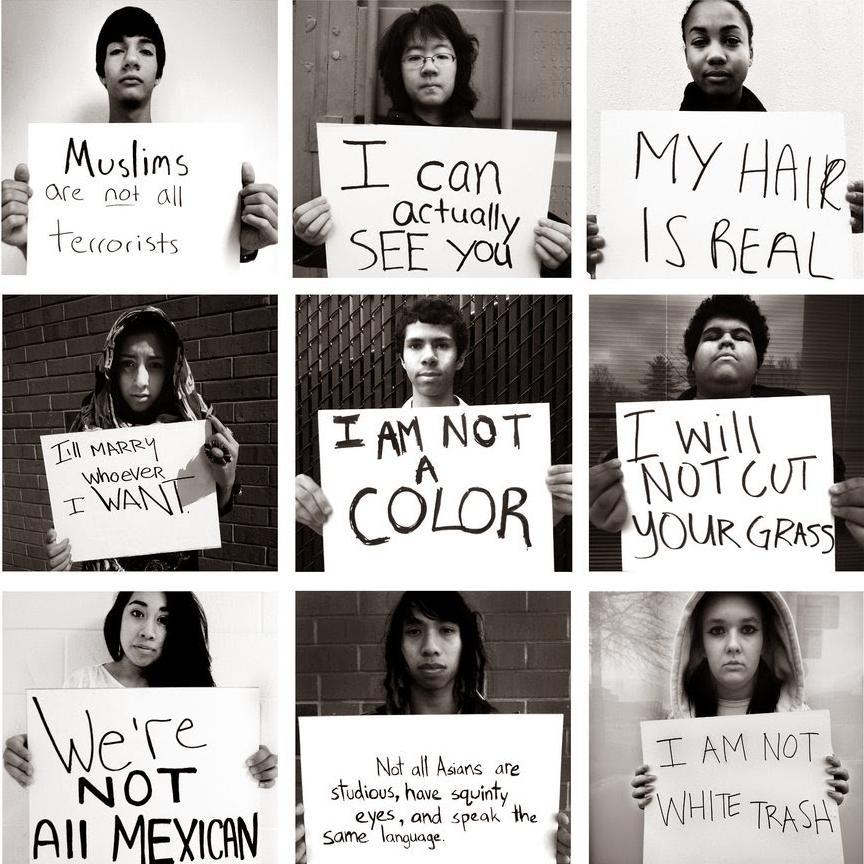
Microaggressions: they add up

According to my buddy Merriam-Webster, a microaggression is: “a comment or action that subtly and often unconsciously or unintentionally expresses a prejudiced attitude toward a member of a marginalized group (such as a racial minority)”

I’m 32 years old and I’d like to think that my patience has grown with my age. This is particularly true when dealing with bad drivers, senior citizens without a filter, and waiting in slow-moving lines at the grocery store. I like learning about social justice, culture, and inclusion and I enjoy discussing these topics at length with friends and colleagues. Marriage, kids, work experience, and friends have helped me grow more patient over time. My patience has also grown when it comes to microaggressions.

Recently, I had a few microaggression incidents happen in the same week and this allowed me to reflect on older experiences. Below are events in weekday order to give readers an idea of what microaggressions can do when bunched together in a particular week:

  • Monday – I meet a stranger and say, “hello” She immediately compliments me by saying, “I really like your accent.” I smile and ignore the comment (I’ve been speaking English for 25 years). I guess I have an accent? I later make a joke to a colleague about having to work on “my accent”
  • Tuesday- I’m working in the east side of Michigan and I walk into a high school to meet with students. A lady greets me at the main office, shakes my hand, and looks me up and down several times. She makes it painfully obvious that she’s staring me up and down. I respond by looking her up and down in an exaggerated manner. I do this mainly sarcastically to let her know how she’s making me feel.She gives me a blank look and proceeds to point me in the right direction. In case your curious, I wear business/professional attire when making my school visits – no different than some teachers and most administrative school professionals.
  • Wednesday – I’m still traveling for work and I meet a secretary at a high school. I say hello and take a seat as I wait to be directed to my presentation room. The secretary comments on my name (Salvador) and proceeds to ask the, “where are you from?” question. I tell her I’m from California and that I’ve lived in Grand Rapids, Michigan for 17 years. She follows up her question with “but where are you from?” Her interrogation would most likely end if I say that I’m Mexican but I refuse to do so (just because). I insist that I’m from California. She appears puzzled but nods, and continues about her business.
  • Thursday – I go to the grocery store and buy a six pack of beer in Wayland, MI, a small town about 20 minutes away from Grand Rapids, the city where I live. The small grocery store is called Harding’s Friendly Market. The clerk in my lane is a white, older woman that looks to be pushing sixty. She asks for my identification and proceeds to look at my driver’s license very carefully. After a few moments, she says, “you’re quite a ways from home, aren’t ya?” I’m literally twenty minutes away from home. I give her a slight smile and say, “I thought this was a friendly market. You’re not very friendly.” She gives me a blank stare and proceeds to complete my transaction.
  • Friday – I stop at a local gas station in Wyoming, Michigan near my home. I put the pump in the tank and go inside my vehicle to scroll through Twitter on my phone. After a couple of minutes, I hear a woman yell, “gas is spilling!” I frantically get out of my car and see gas all over the side of my car. A larger white man about my age with a shaved head is standing almost directly next to my vehicle. He has a smirk on his face and is staring at the puddle of gas by my vehicle. It appears that he had seen the gas spilling from the start. I make direct eye contact with him and in a snarky and grammatically incorrect way HE SAYS, “no fumar today amigo” or “don’t smoke today friend” I give him a dirty look and sarcastically thank him for the advice. He stares at me with a blank look on his face and doesn’t break eye contact with me as he gets into his car.

It’s hard to be patient and it only takes a bad day to lose it. It could be a long or bad day at work. Perhaps one of my daughters is sick and I’m running on three hours of sleep. Or it could be that I’ve been fighting a migraine, I’m behind on work deadlines, and I haven’t had time to go grocery shopping. You add any of these situations to a microaggression after a microaggression after a microaggression and you have an angry brown man.

My point is that the next time you run into a black or brown person, someone with a disability or from an underrepresented group and they get upset over a potential insensitive remark or action, please know that this is not the first time this person has experienced a negative comment, a bad joke, a curious question, or a snarky sarcastic comment. This happens more often than you think. So, be patient.
The 13th: Thoughts on Mass Incarceration and What It Means for our Children

The 13th is a thought-provoking documentary where scholars, activists, and politicians analyze the criminalization of African Americans and the U.S. prison boom. I started taking notes during the film and I quickly realized that there is enough interesting facts, quotes, and information to write an entire blog series or book. The 13th takes its viewers through a history lesson followed by recent and current systemic issues that criminalize people of color; more specifically black people. The following are highlights that struck me as impactful while watching the film last year.

Notes, Facts and Figures

  • The United States is home to 5% of the world’s population but 25% of the world’s prisoners. 1 out of 4 human beings in the world are locked up in the land of the free.
  • 2.23 million people are in jail up from 300,00 in 1972 – the U.S. has the highest rate of imprisonment in the world. 357,292 in 1970 to be exact – 513,900 in 1980 after Nixon began the incarceration movement.  759,100 in 1985 under Reagan.  1,179,000 in 1990, 2,015,300 in 2000. Read these numbers again and let it sink in for a minute.
  • After the civil war, African Americans were arrested in mass through a 13th amendment loophole.
  • Slavery ended in December 1865 but people’s rights were taken away until the Civil Rights movement. Note that slavery ended but systemic racism and oppression continued in different forms.
  • Richard Nixon’s call for law and order rhetoric started the mass incarceration movement; a new form of systemic racism and oppression.
  • Nixon coined the term of world on war and president Reagan turned it into a literal one. The modern world on drugs was declared by Ronald Reagan.
  • Reagan ultimately takes the problem of economic inequalities of hyper segregation of American cities and criminalizes all of that in the form of the world on drugs.
  • The history of interracial rape is far more marked by white men against black women that black men against white women.

“The federal crime bill of 1994 by Bill Clinton was responsible for a massive expansion of the law system. It increased funding to build prisons and put 100,000 police officers on the street. This was far more harmful than Raegan or Nixon because it built the infrastructure that we see today – the militarization, swat teams, etc.”

  • Fred Hampton pulled together blacks, whites, native Americans, and Latinos – at the age of 21 and he was killed by police. They literally shot him in his bed and his pregnant wife.
  • ALEC is a way for corporations to influence which laws get proposed. Stand your ground laws are examples of ways corporations made money because it boosted gun sales (i.e. Walmart).
  • CCA – Corporate Corrections of America is a 1.7 billion business that gets rich off of punishment.
  • SB 1070 allowed police officers to arrest immigrants based on looks. Detention facilities are prisons with a different name. Note that Donald Trump is quickly trying to bring this back.
  • For corporations, business is booming. Examples of prison labor products: sports uniforms, Idaho potatoes, hats, JC Penny jeans, and Victoria Secret clothing. Let’s clarify a bit: corporations are profiting from punishment.

“97% of people that are locked up had plea bargain and that is one of the worst violations of human rights that we have in the United States. If you exercise the right to a trial, and are convicted, you will be punished more.”

  • 30% of the Alabama population cannot vote due to felony convictions.

“The likelihood of white men going to prison is 1 in 17 and 1 in 3 black males during their lifetime. Black men account for 6.5% of U.S. population and make up 40.2% of the prison population. We now have more black men under criminal supervision than all the slaves back in the 1850s.”

The 13th depicts U.S. history racism and oppression through different systems that include; Slavery, Jim Crow terror and lynching, and now mass incarceration where black people are prevented from voting and are unable to find a job after prison.

Police Brutality Riots (largest in recent history)

  • Rodney king, Detroit riot in 1967, Newark riot in 1967, Harlem 64, Watts 65 – every single riot was as a result of police brutality.
  • There has never been a period in our history where the law and order has not acted against the African American black community. To ignore that context means you cannot have an informed debate about what is going on today.
  • The murder of Emmett Till shocked the community into creating a movement. The whole black world could see what could happen. Dr. King used video and photos hoping that your basic humanity could be recognized. We are still using video and photos to attempt to shock the community and this is still a big tool to exploit police brutality and discrimination.
  • Police violence is not the problem in and of itself – rather a much larger brutal system of social and racial control known as mass incarceration that authorizes this kind of police violence.

“We are the product of the history that our ancestors chose.”

The Atlantic’s Mass Incarceration visual does a great job of summing up how mass incarceration has a deep effect in the lives of our youth – particularly Black children. 1.2 million African American children with a parent who is incarcerated is about 1 in 9. Research shows that these children are then affected in many ways including; diminished school achievement, parental problems, behavioral problems, depressive symptoms, and acting out. There’s also evidence that these kind of negative effects are concentrated more with young boys than young girls.

The 13th is a powerful, well organized piece of work that forces viewers to become educated on the fact that systemic racism and discrimination continues to exist in different forms despite social and technological advances. The question isn’t whether systemic racism will end during my lifetime but rather; what new form of systemic racism will come next? The 13th asks, what’s the next phase? Perhaps the Donald Trump administration will answer this question.


Critical Race Theory Series: Brown v. Board of Education and School of Choice

About this blog series: This is the second blog post that explores Critical Race Theory (CRT)  as I seek to better understand race-related issues in America. My hope is that I develop a stronger understanding of both law and race relations and apply this knowledge to personal and professional projects related to inclusion and equity in my community. 

Critical Race Theory: The Key Writings that Formed the Movement begins with a foreword by Dr. Cornel West and Derrick A. Bell Jr.’s Serving Two Masters: Integration Ideals and Client Interests in School Desegregation Litigation. Bell’s article also breaks down the 1954 landmark decision of Brown v. Board of Education and quickly moves to affirmative action and how desegregation was later used by White policymakers to obstruct the efforts to establish an equitable process that would help level the playing field for people of color.

According to Bell, the argument behind desegregating schools was that “In essence, the arguments are that blacks must gain access to white schools because “equal educational opportunity” means integrated schools, and because only school integration will make certain that black children will receive the same education as black children.” As well intended and social just as it is to desegregate schools, Bell argues that the rationale or theory behind this movement was flawed from the beginning because this theory fails to encompass the complexity of achieving equal educational opportunity for children to whom it so long has been denied (CRT Bell, 1995, pg7). Little attention was given to make black schools educational effective; furthermore, the disinclination of white parents to send their children to black schools. As true is this was back in the 70s and 80s, it remains true in 2017.

Bell cites The Detroit Case and The Atlanta Case as examples of predominantly black school districts that disagreed with desegregation over the improvement of educational quality. Parents opposed having their children bused miles away simply to abide by the desegregation laws backed by the NAACP. In the Atlanta Case, lawyers for the local NAACP branch, worked out a compromise that led to the hiring of a number of blacks in top administrative positions, including a black superintendent of schools. At the time, Dr. Benjamin E. Mays, one of the most respected black educators in the country, stated:

“Black people must not resign themselves to the pessimistic view that a non-integrated school cannot provide Black children with an excellent educational setting. Instead, Black people, while working to implement Brown, should recognize that integration alone does not provide a quality education, and that much of the substance of quality education can be provided to Black children in the interim.” (CRT, 2015)

Dr. Mays’s thoughtful statement made it clear that racial separation is only the most obvious manifestation of this subordination and that there is still a lot of work to be done to assure that all students, including black students, receive high quality education. Sadly, Bell’s argument and the lack of progress in developing high quality education in addition to the Brown decision is still true in 2017. Black schools are still provided with unequal and inadequate school resources and black parents are excluded from meaningful participation in school policy-making and this is as least as damaging to black children as enforced separation.

Michigan has school choice and some would argue that this has accelerated segregation by race, by class, by ability, by special education status, and by language. Detroit is a perfect example that school of choice is simply not the answer. More than 2,900 students using school of choice leave East Detroit (2015 figures). Most head out of the districts that were far whiter than East Detroit, which saw the white population of its schools fall from 50 percent to 18.6 percent from 2009 to 2015 (Michigan Department of Education).

Despite the work that was done during the civil rights era, what came of Brown, and other victories, we have simply not done enough to educate Black children. W.E.B. Du Bois’ words are sadly still accurate, despite having him remind us of our reality back in 1935. Bell reminds us of this in Serving Two Masters by using a quote from Du Bois:

The Negro needs neither segregated schools nor mixed schools. What he needs is Education. What he remembers is that there is no magic, either in mixed schools or in segregated schools. A mixed school with poor and unsympathetic teachers, with hostile public opinion, and no teaching of truth concerning black folk, is bad. A segregated school with ignorant placeholders, inadequate equipment, poor salaries, and wretched housing, is equally bad. Other things being equal, the mixed school is the broader, more natural basis for the education of all youth. It gives wider contacts, it inspires greater self-confidence; and suppresses the inferiority complex. But other things seldom are equal, an in that case, Sympathy, Knowledge, and the Truth, outweigh all that the mixed school can offer (W.E.B. Du Bois, 1935).

Both W.E.B. Du Bois and Derrick Bell understood that the desegregation of schools was a component that would move our society towards a more inclusive and equal space but they  were both aware that this was only a step towards equity and that society needs to work and strive for equal funding, equal salaries, and equal neighborhoods. We have yet to listen to Bell and Du Bois and 50 years later, we are still separate and still unequal.

Critical Race Theory Series: Introduction

I don’t particularly care for New Year resolution plans but one of my goals in 2017 is to become more knowledgeable about Critical Race Theory (CRT). I have read articles but I’ve never truly explored the legal components of CRT and the impact of law in race discussions. This is the beginning of a CRT blog series where I’ll share CRT findings and how the theory is applicable in my community in Michigan. President Trump has declared that he plans enforce the United States laws and I figure now is as good a time as any to educate myself on law, race, and social justice in America.

I’m currently reading Critical Race Theory: The Key Writings that Formed the Movement edited by Kimberle Crenshaw, Neil T. Gotanda, Gary Peller, and Kendall Thomas. The book offers a compilation of scholarly articles that presented new paradigms for understanding racial injustice and seeing the links between race, gender, sexual orientation, and class. Mexigander was founded on the idea that we all have multiple identities that are intertwined and Critical Race Theory scholars like Kimberle Crenshaw set the foundation and historical context that has helped me think critically about how I can contribute solutions to race issues that have been prominent in America for hundreds of years.

Critical Race Theory (CRT) research is a compilation of the growing body of legal scholarship related to the importance of race in law. Critical Race Theory: The Key Writings that Formed the Movement (1995), briefly explains CRT in the following two points:

  • CRT first seeks to understand how a regime of white supremacy and its subordination of people of color have been created and maintained in America, and in particular, to examine the relationship between that social structure and professional ideals such as the “rule of law” and “equal protection.”
  • CRT research and writings desires to not merely understand the vexed bond between law and racial power but to change

This blog series will continue to explore CRT articles by starting with the civil rights movement and how some of the struggles that existed during the 60’s and 70’s are still very prevalent in 2017.


Stand Up Against Hate: Even on Social Media

This week, Alton Sterling and Philando Castile were fatally shot by police officers. There is no way to adequately express all of the emotions that are being felt regarding ongoing killing of black men and Alton Sterling and Philando Castile are the most recent. A lot is required of us to address what is happening in our communities and bigots and racists come out by the numbers during times like these on social media to express their points of views. My advise: don’t be a bystander.

Equity and justice is not about validating everyone’s perspective. White supremacy and racism are not valid perspectives.

If you have social media “friends” that happen to be bigots and/or racists, either delete them from your life or make a strong statement that you are against such behavior or mindsets… before eventually deleting them from your social media circles. When it comes to Facebook or Twitter, I decided long ago that arguing with bigots or trying to educate them on racism, social justice, and inequity is often draining and a waste of my time. I choose to delete bigots that follow or “friend” me on Facebook. If you choose to let these people continue to undermine your comments, thoughts, or posts on social justice and equity and keep these people around, you too are part of the problem and are essentially a social media bystander.

It is harder to change ideology than practice. I choose to practice ways to educate students, family, friends, and anyone else that is looking to have a discussion on equity, social justice, and intersectionality. I choose to eliminate people that don’t bring educated, fact-based knowledge to these conversations. Equity and justice is not about validating everyone’s perspective. White supremacy and racism are not valid perspectives.

In today’s world, it is easier to be a quiet racist than a vocal anti-racist. Social media bigots and racists are everywhere and I often see friends posting about equity and justice;  the killing of Sterling and Castile being the latest issues, only to see comments from bigots attempting to undermine their posts by making flat out racist comments. If you choose to surround yourself with these so-called friends, be a vocal anti-racist. Allowing people to voice their so called opinions by standing aside as their “friend” is unacceptable.

A lot of my friends and I share a similar mindset when it comes to social justice issues and some may even argue that I am singing or preaching to the choir. If that’s the case, I’ll finish my rant by stating something I heard a while back: Being a part of the choir requires you to get up and sing. Dialogue is not action. If you surround  yourself with people that perpetuate hate, racism, and violence and you don’t stand up for social justice, you too are a part of the problem.

GVSU Latin@ Graduation Celebración

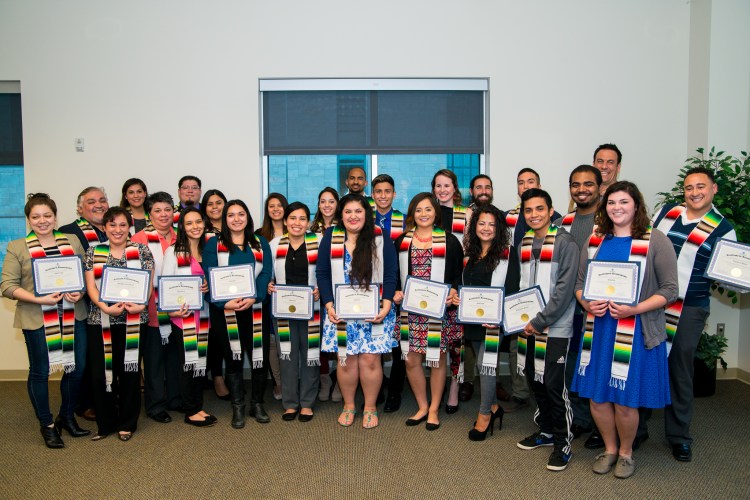
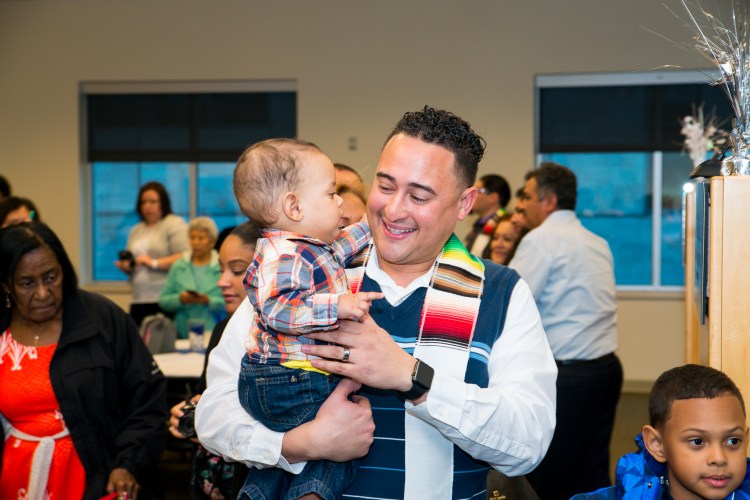
My latest project was being a part of the organizing committee for Grand Valley State University’s first Latin@ Graduation Celebración where student graduates were honored while joined by their families, friends and loved ones. It was inspiring to listen to students come up to the stage to thank their parents, mentors, and friends.

_DSC2867

GVSU had over 3,000 students graduate this winter semester and over 240 of the students self-identify as Latino/a. There are over 25,000 students at Grand Valley and Latin@ students compose 4.6% of the population. This is truly a milestone for many students that are first generation college graduates.

_DSC2873

A big thank you goes out to the Grand Valley State University Latin@ Faculty and Staff Affinity group, the Office of Multicultural Affairs, and the Division of Inclusion & Equity for making this happen. This is only the beginning!

_DSC2870

Congratulations graduates!

ALSAME Fundraiser

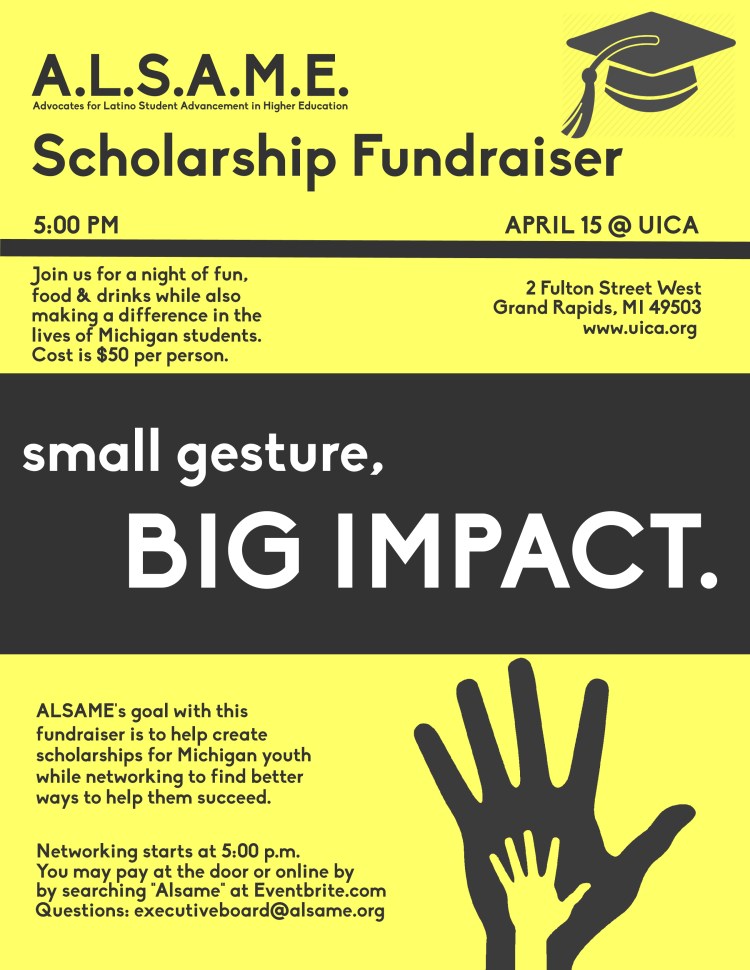
My latest project includes being a part of the fundraising committee for Advocates for Latino Student Advancement in Michigan Education (ALSAME). The fundraiser will take place at the UICA in downtown Grand Rapids on April 15th at 5pm.

Our goal is to raise funds that will support Latino/a students through scholarships. Tickets are $50 at the door or you can pay online through Eventbrite. We will have El Granjero Mexican Grill food, agua de horchata, limonada and desserts. Cocktails will be available for purchase and live music will be playing until 10pm.

Join us for a night of networking, good eating, and a few drinks while making a difference in the lives of Latino/a youth. The flyer below was designed by yours truly; spread the word!

ALSAMEFLYERyellow

What Would César E. Chávez Do?

César E. Chávez’s birthday is on March 31st and I would like to explore a bit of historical information before we celebrate his legacy and that of the united farmworker movement. I would also like to take a moment to ponder what Chávez would think of the progress or lack there of when it comes to farmworker human rights almost 23 years after his death.

According to the United Farmworker Organization, in May of 1972 and a decade after César Chávez started the United Farmworkers Movement (UFW), Legislature in his home state of Arizona pushed through a bill sponsored by agribusiness denying farmworkers the right to strike and boycott during harvest seasons, and effectively making it impossible for them to organize.

The UFW asked to meet with Republican Governor Jack Williams, to appeal for him to veto the legislations. Instead, the governor ordered state troopers to bring him the bill and he signed it within an hour after the passage. In response to the protest by farmworkers, the governor remarked, “As far as I’m concerned, those people don’t exist.” When news of the law’s enactment reached him, César, with UFW co-founder Dolores Huerta by his side, returned to Arizona and began a 25-day water-only fast and so Chávez’s legacy began to grow.

chavez and huerta

“As far as I’m concerned, those people don’t exist.” – Governor Jack Williams

There is much more to Chávez and the UFW’s rich history but the decision to respond to the governor by taking action tells us a lot about Chávez’s will, passion, and loyalty to farmworkers and their movement. Understanding the UFW and Chávez’s history is important; particularly as the end of March gets closer and we look to honor Chávez by holding dinners, rallies, marches and asking local politicians to speak in his honor as they claim to support farmworkers and Latinos simply by showing up.

Chávez and farmworkers often faced and opposed politicians and law enforcement that clearly stated that they believed farmworkers did not deserve human rights. Jack Williams didn’t believe that farmworkers even existed; essentially refusing to believe that they were people. In 2016, farmworkers face a tougher challenge because there are local, state, and federal politicians and police officers who claim to stand with Latinos and claim to support farmworker communities but do little to nothing to actually help them as they often face the same or more challenging struggles that they faced when Chávez was picketing and organizing.

In Frank Bardacke’s written and definitive biography of César Chávez, he describes Chávez as a man of action. Chávez organized and led boycotts, strikes, fasted, and indulged in self-sacrifice during tough bargaining. He also exercised ruthless central union control, not allowing organizing initiatives to develop without his approval. Chávez wasn’t perfect but he stood up for what he believed in and organized people to peacefully stand together. As community leaders today we should stand together and remember César but we should also remember that the fight for farmworker rights is far from over and that action is still required.

I believe we should remember more than César  E. Chávez’s name and legacy. We should stop pretending that Chávez and the UFW beat the system. We should honor leaders like Chávez and Huerta by standing together and shedding light on current farmworker issues. We need to use our platform to call young people to action. Taking action is, after all, what Chávez would want us to do. So let’s take a moment to stop applauding local politicians at rallies and marches and let’s ask them how they plan to help farmworkers and their families. If politicians truly want to help, they should provide a plan of action or at the very least, ask us to help them create one. I believe that if Chávez was alive today, he would ask difficult questions and take appropriate action when required.

We need to do a better job of including current farmworkers and their families at our rallies, marches, and dinners. We need to give current farmworkers a platform and allow them to educate our politicians at these events. If we choose to ignore or leave farmworkers out of Chávez rallies, marches, and social gatherings, we are doing exactly what former governor Jack Williams did; we are pretending they don’t exist.

Free Translation Work

Need to have a flyer, word document or file translated? Mexigander will do a one-page translation for free.Your organization or company simply needs to meet the following guidelines:

  • Submit a document that needs to be translated from English to Spanish
  • One page maximum (preferably 300 words or less)
  • Send original document and request to: mexigander@gmail.com

Once the translation request is received, Mexigander will confirm receipt and provide an approximate completion date.

We have over 15 years of experience translating documents for healthcare, business, non-profit, and government organizations. Learn more about us.

*Offer is available for a limited time. 

Not You’re Grandpa’s Form of Racism

I recently went to a Tim Wise event where he spoke about racism, white supremacy, and bigotry. He touched on a lot of issues related to racism and how different racism is now compared to thirty, forty or fifty years ago.

“…there is one thing that can be said for such folks in the old days. When they were bigots, they were honest enough to just tell you. No prevarication, no hesitation, no pretending to be enlightened or remotely compassionate, no cloying assurances about one’s black friends, or how they once dated an Asian woman, or about being 1/16th Native American on their mother’s father’s side. They let you know where they stood, and however offensive and injurious their attitudes were, at least you could plan accordingly. You could avoid them, confront them, or plot for their overthrow, but either way, you knew who the enemy was.” Tim Wise 

People hide their racist comments, feelings, or beliefs and use the “gray area” or “fake niceness” as forms of racism. In a way, this is a step forward because they know their feelings or beliefs are either or wrong or not accepted by most members of society. Instead, they choose to display or deliver their true feelings of hate and ignorance in other ways, like supporting racist politicians at the voting booths, writing racist remarks on the Internet, and finding simple reasons to dislike people that are “different.”

photo by 21st Century Racism

Donald Trump, one of the most culturally ignorant public figures in the U.S. is currently running for president and as of October 2015, is the Republican party’s front runner for the presidency. He is leading several political polls and that requires a strong following. By supporting such an ignorant and hateful person, his supporters fall into the grey area category of bigotry and racism. I’ve yet to meet someone in my community that openly identifies as a Donald Trump supporter and I find this fascinating. How can a man that is leading political polls requiring thousands of supporters not have a single soul that openly admits to backing his ideas and beliefs? These people are our neighbors, coworkers, and acquaintances. They work at our schools, court rooms, hospitals, and restaurants.

I hate racism but I hate the grey area of racism even more.

Immigration Facts

A lot of people don’t like how culturally diverse the U.S. is and that our workforce is composed of both documented and undocumented immigrants. I challenge these individuals to provide FACTS about ways that immigration is hurting our economy or way of life. I repeat, FACTS. It’s nice to have emotions, feelings, and beliefs but if you don’t have concrete facts to affirm those feelings, then you risk being viewed as ignorant, a bigot or simply uninformed. Don’t be that person. Be better than Donald Trump. Below is a list of facts about immigration. Read them, believe them, and use them.

  • Almost 40% of undocumented immigrants come by plane and overstay visas.
  • It would cost 137 billion dollars (ICE estimates) in order to deport 11 million undocumented immigrants. $12,500 per person.

  • With an estimated cost of $4 million per mile, building an additional 700 miles of a border wall along the U.S. – Mexican border would cost about $2.8 billion.
  • Thousands of American companies hire and benefit from undocumented immigrants.

  • Immigrants pay taxes: The 11 million-plus undocumented immigrants living in the United States contribute an estimated $11.84 billion in state and local taxes each year, according to a study by the Institution of Taxation and Economic Policy. That’s a conservative estimate based on 2012 numbers. It’s now thought to be closer to $12.6 billion.
  • Data from 50 states calculates that comprehensive immigration reform would boost the U.S.’ annual revenue flow by an additional $2.2 billion.

  • Mass deportation would drain the U.S. economy of some $2.5 trillion over 10 years, according to the 2010 study by the Center of American Progress.
  • Promoting a path to legalization and other immigration reforms would boost the U.S.’ economy by $1.5 trillion over a ten year period.

    by Alberto Ledesma
    Art by Alberto Ledesma


Facts provided by Tim Rogers, Fusion

More art by Alberto Ledesma 

What Is Culture?

What is culture? Would you be able to provide an honest, direct, and clear response? I like Jeane Kirkpatrick’s definition below and plan to use it at a future workshop, panel discussion or conversation.

“Culture includes the entire symbolic environment. Culture defines reality: what is, what should be, what can be. It provides focus and meaning. It selects out of the myriad of events and interactions in the world those we pay attention to. Culture tells us what is important; what causes what, how events beyond our lives relate to us. Culture gives us values and standards of value. What we may distinguish analytically (and at our peril) as fact, value, and goal is existentially integrated in culture – in identifications, expectations, and demands of individual persons.” Jeane Kirkpatrick

Jeane J. Kirkpatrick, was the Reagan administration’s first United Nations ambassador and a beacon of neoconservative thought who helped guide American military, diplomatic and covert action from 1981 to 1985.

Leading Without a Title

I recently read Mark Sanborn’s You Don’t Need a Title To Be a Leader: How Anyone, Anywhere, Can Make a Positive Difference. It’s a short and easy read. I’m a self-proclaimed slow reader and finished the 100-page book in about three hours. There won’t be many surprises for those that have worked in the professional sector for at least five years. It does however, provide a nice refresher and insight of things we tend to take for granted.

“Intent without action is daydreaming.”

The points below stood out to me after finishing the book (pages in parenthesis):

  • 85% of people would pass up on a bigger title for a 10% increase in pay (6)
  • “At this school, you won’t make a difference, you will be the difference” (9)
  • “In my opinion, fame is based on what you get in life, but true greatness is based on what we give in life. It is contribution through action.”(14)
  • How do I get people to trust me? (54)
    • If you don’t know something, say so.
    • Don’t make promises you can’t keep.
    • Under promise and over deliver.
    • Be careful to create realistic expectations.
  • “Confront problems not people.” “Focus on what went wrong not on who went wrong.” (57)
  • Good interview questions (especially for leadership positions (59, 60):
    • What motivates you?
    • What do you like about work the most? What is your favorite activity?
    • What do you like to do the least?
    • Whom do you enjoy working with? Whom do you dislike working with, and why?
    • What annoys you about being part of a team?
    • What do you enjoy about teamwork?
    • What values do you try to live your life by?
    • What information or ideas do you have that would be beneficial?
  • Call for action – Too many communicate without a clear call to action. Every email, phone call, voice mail, conversation, or speech should conclude with a request for action, with a “Let’s do it.” Let’s move forward, take the next step, get involved, play our part, et cetera (67).
  • “Having a good ideas isn’t enough – you have to be able to implement them.” (70)
  • “Intent without action is daydreaming.” (71)

Overall, You Don’t Need a Title To Be a Leader: How Anyone, Anywhere, Can Make a Positive Difference is a good and quick read. Sometimes, a refresher on leadership principles can help us reflect and move forward. If you’re in a leadership position and feel like you need a pick me up, take a couple of hours to read this book and recharge.

GVSU Laker Familia

I’m excited to be a part of the GVSU Laker Familia Orientation committee for the second year in a row. Laker Familia is an orientation program specifically designed to introduce new Latino students to GVSU’s faculty, staff, and connect students to resources and services that will support their academic, cultural, and emotional well-being.  The three-day orientation promotes and facilitates meaningful interactions between Latino/a students and mentors with the goal of improving academic success, retention, and graduation. REGISTER TO VOLUNTEER TODAY! 

Help us welcome over 200 Latin@ students and their familias to GVSU’s campus on Sunday, August 23rd for an early-move in. It is truly a rewarding experience and a wonderful way to give back to both the Latino and GVSU communities.

LFO pic of sal