
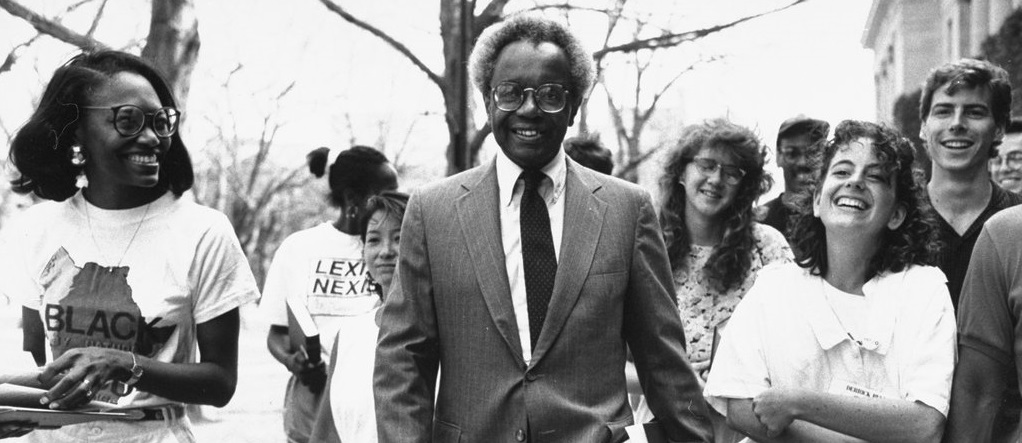
About this blog series: This is the second blog post that explores Critical Race Theory (CRT) as I seek to better understand race-related issues in America. My hope is that I develop a stronger understanding of both law and race relations and apply this knowledge to personal and professional projects related to inclusion and equity in my community.
Critical Race Theory: The Key Writings that Formed the Movement begins with a foreword by Dr. Cornel West and Derrick A. Bell Jr.’s Serving Two Masters: Integration Ideals and Client Interests in School Desegregation Litigation. Bell’s article also breaks down the 1954 landmark decision of Brown v. Board of Education and quickly moves to affirmative action and how desegregation was later used by White policymakers to obstruct the efforts to establish an equitable process that would help level the playing field for people of color.
According to Bell, the argument behind desegregating schools was that “In essence, the arguments are that blacks must gain access to white schools because “equal educational opportunity” means integrated schools, and because only school integration will make certain that black children will receive the same education as black children.” As well intended and social just as it is to desegregate schools, Bell argues that the rationale or theory behind this movement was flawed from the beginning because this theory fails to encompass the complexity of achieving equal educational opportunity for children to whom it so long has been denied (CRT Bell, 1995, pg7). Little attention was given to make black schools educational effective; furthermore, the disinclination of white parents to send their children to black schools. As true is this was back in the 70s and 80s, it remains true in 2017.
Bell cites The Detroit Case and The Atlanta Case as examples of predominantly black school districts that disagreed with desegregation over the improvement of educational quality. Parents opposed having their children bused miles away simply to abide by the desegregation laws backed by the NAACP. In the Atlanta Case, lawyers for the local NAACP branch, worked out a compromise that led to the hiring of a number of blacks in top administrative positions, including a black superintendent of schools. At the time, Dr. Benjamin E. Mays, one of the most respected black educators in the country, stated:
“Black people must not resign themselves to the pessimistic view that a non-integrated school cannot provide Black children with an excellent educational setting. Instead, Black people, while working to implement Brown, should recognize that integration alone does not provide a quality education, and that much of the substance of quality education can be provided to Black children in the interim.” (CRT, 2015)
Dr. Mays’s thoughtful statement made it clear that racial separation is only the most obvious manifestation of this subordination and that there is still a lot of work to be done to assure that all students, including black students, receive high quality education. Sadly, Bell’s argument and the lack of progress in developing high quality education in addition to the Brown decision is still true in 2017. Black schools are still provided with unequal and inadequate school resources and black parents are excluded from meaningful participation in school policy-making and this is as least as damaging to black children as enforced separation.
Michigan has school choice and some would argue that this has accelerated segregation by race, by class, by ability, by special education status, and by language. Detroit is a perfect example that school of choice is simply not the answer. More than 2,900 students using school of choice leave East Detroit (2015 figures). Most head out of the districts that were far whiter than East Detroit, which saw the white population of its schools fall from 50 percent to 18.6 percent from 2009 to 2015 (Michigan Department of Education).
Despite the work that was done during the civil rights era, what came of Brown, and other victories, we have simply not done enough to educate Black children. W.E.B. Du Bois’ words are sadly still accurate, despite having him remind us of our reality back in 1935. Bell reminds us of this in Serving Two Masters by using a quote from Du Bois:
The Negro needs neither segregated schools nor mixed schools. What he needs is Education. What he remembers is that there is no magic, either in mixed schools or in segregated schools. A mixed school with poor and unsympathetic teachers, with hostile public opinion, and no teaching of truth concerning black folk, is bad. A segregated school with ignorant placeholders, inadequate equipment, poor salaries, and wretched housing, is equally bad. Other things being equal, the mixed school is the broader, more natural basis for the education of all youth. It gives wider contacts, it inspires greater self-confidence; and suppresses the inferiority complex. But other things seldom are equal, an in that case, Sympathy, Knowledge, and the Truth, outweigh all that the mixed school can offer (W.E.B. Du Bois, 1935).
Both W.E.B. Du Bois and Derrick Bell understood that the desegregation of schools was a component that would move our society towards a more inclusive and equal space but they were both aware that this was only a step towards equity and that society needs to work and strive for equal funding, equal salaries, and equal neighborhoods. We have yet to listen to Bell and Du Bois and 50 years later, we are still separate and still unequal.
 Modos
Modos 