
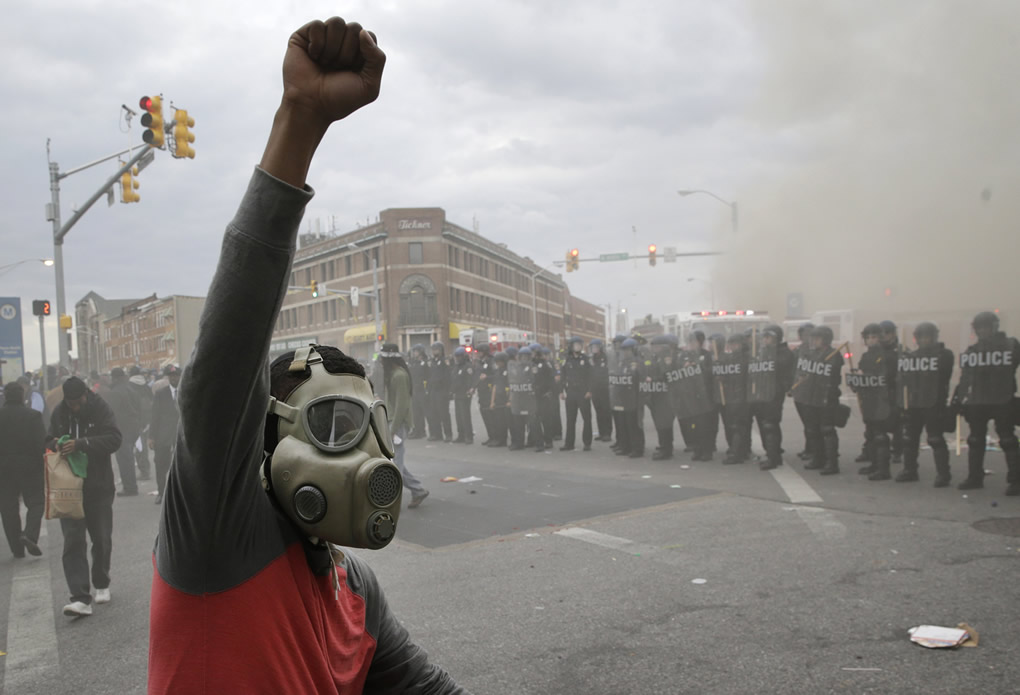
The current riots and protests throughout Baltimore, Maryland were sparked by the death of Freddie Gray, a 25-year old that died days after suffering a spinal cord injury while in police custody. Protests in Baltimore took a destructive turn in recent days, as cars were set on fire, stores were looted and many were injured. Thousands of people have protested peacefully but the media has focused on violence, public destruction, and looting. The protests and riots are in response to decades of inequality and oppression but why isn’t the mass media focused on the root of the problem in Baltimore?
NPR published an article that looked to the past in order to to make sense of Freddie Gray’s death and the subsequent unrest in Baltimore. I found James Baldwin’s 1968 response to an interviewer’s question especially noteworthy given the current situation in American society:
QUESTION: How would you define somebody who smashes in the window of a television store and takes what he wants?
BALDWIN: Before I get to that, how would you define somebody who puts a cat where he is and takes all the money out of the ghetto where he makes it? Who is looting whom? Grabbing off the TV set? He doesn’t really want the TV set. He’s saying screw you. It’s just judgment by the way, on the value of the TV set. He doesn’t want it. He wants to let you know he’s there. The question I’m trying to raise is a very serious question. The mass media-television and all the major news agencies-endlessly use that word “looter”. On television you always see black hands reaching in, you know. And so the American public concludes that these savages are trying to steal everything from us, And no one has seriously tried to get where the trouble is. After all, you’re accusing a captive population who has been robbed of everything of looting. I think it’s obscene.
James Baldwin’s words from 1968 still ring true in 2015. The people that were called “looters” back in the 60’s are now called “thugs”and just like in the 1960’s, the the media continues to avoid discussing the root of the problem.
Jon Stewart best summarized how the media’s poor representation of the oppressed continues to miss the underlying factors behind the protests and riots:
“…we can continue to ignore the roots of how systemically, historically disenfranchised many African American communities still are; only paying attention to them when we fear their periodic fiery ball of anger threatens to enter our air space, like some kind of Alex Haley comet; and once again breathing a blissful sigh of forgetful relief when it’s another near miss.”
Stewart’s commentary on CCN and most of the media’s reaction to the protests is spot on. He reminds us that the Baltimore protests and riots are a response to decades of inequality and oppression and thus the root of the problem. Riots take place when voices are continuously ignored.
Stewart also gives perhaps one of the most powerful facts associated with the protester’s anger and frustration when he says,
“Since 2011, the city of Baltimore has paid out close to 6 million dollars in court judgment or settlements to victims of police abuse.”
And as huge as that figure is, an article by the Baltimore Sun reveals an even more staggering number:
“Over the past four years, more than 100 people have won court judgments or settlements related to allegations of brutality and civil-rights violations.”
If you’re imagining that they were all men in their twenties, think again. The Baltimore Sun goes on to reveal the following:
Victims include a 15-year-old boy riding a dirt bike, a 26-year-old pregnant accountant who had witnessed a beating, a 50-year-old woman selling church raffle tickets, a 65-year-old church deacon rolling a cigarette and an 87-year-old grandmother aiding her wounded grandson. Those cases detail a frightful human toll. Officers have battered dozens of residents who suffered broken bones — jaws, noses, arms, legs, ankles — head trauma, organ failure, and even death, coming during questionable arrests. Some residents were beaten while handcuffed; others were thrown to the pavement.
The media and many people in the U.S. continue to miss the point and we refuse to dissect the real issues that people of color face. We need to acknowledge the roots of how systemically, historically disenfranchised many African American communities still are. Until the system makes strong and measurable progress towards helping ALL of the people in Baltimore, we shouldn’t be shocked when the African American community decides to rise, speak, and act in an attempt to be heard.
Perhaps a Langston Hughes poem called “Warning” best describes Baltimore’s current situation:
“Negroes-Sweet and docile. Meek, humble and kind. Beware the day They change their mind.”
 Modos
Modos 